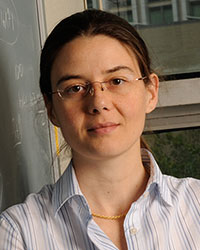
Paola Cappellaro
Ford Professor of Engineering
Professor of Nuclear Science and Engineering and Professor of Physics
pcappell@mit.edu
617-253-8137
26-303

Ford Professor of Engineering
Professor of Nuclear Science and Engineering and Professor of Physics
pcappell@mit.edu
617-253-8137
26-303
Ph.D., Nuclear Science and Engineering, Massachusetts Institute of Technology, 2006
M.S., Applied Physics, École Centrale Paris, 2000
B.S/M.S., Nuclear Engineering, Politecnico di Milano, 2000
The development of new technologies at scales approaching the quantum regime is driving new theoretical and experimental research on control in quantum systems. The implementation of quantum control would have an enormous impact on a wide range of fields such as chemistry, nuclear magnetic resonance, microelectronics, and precision metrology. Quantum control finds an ideal application in quantum information processing (QIP), which promises to radically improve the acquisition, transmission, and processing of information. To reach this goal it is necessary to improve both the experimental techniques and the coherent control theory of quantum bits (qubits), as well as to gain a deeper knowledge of the mechanisms of decoherence, which must be studied and fought against. Below are some projects that my group is working on.
The Nitrogen-Vacancy (NV) center has recently emerged as a versatile tool for magnetic resonance,quantum optics, precision measurement and quantum information processing. The NV center is a localized impurity in diamond, consisting of a nitrogen substitutional atom close to a vacancy.Single NV centers are addressed using optical scanningconfocal microscopy and can be efficiently prepared, manipulated and measured with optical and microwave excitation, even at room temperature. The system comprising the NV electronic spin and close-by nuclear spins (N and 13C) is an excellent candidate for the implementation of small quantum registers capable of simple quantum algorithms with very high fidelities. These quantum registers can then in turn be connected via photon entanglement or direct dipole-dipole coupling. In this project, we will develop high-fidelity methods for controlling the electronic-nuclear spin system.
In recent years metrology and quantum information science have emerged as complementary areas of research. We aim at applying the principles of quantum information science to the development of nano-scale magnetic field sensors based on single spin qubits in diamond. We focus on improving the diamond magnetometer readout, enhancing its coherence, improving its spatial resolution and devising strategies to achieve sensitivity beyond the Heisenberg limit. Ideas and techniques from quantum information science are critical in achieving these goals, from quantum non-demolition measurement, to dynamical decoupling and spin squeezing.
A system composed of nuclear or electronic spins could play an important role -complementary to cold atoms and molecules- in the simulation of condensed matter systems. For example, well-known NMR pulse sequences can be used to experimentally simulate the transport of quantum information in room temperature linear chains of spins coupled by the dipolar interaction. The next step is to demonstrate transport of information between quantum registers via quantum wires in a highly mixed state. We will use solid-state NMR to study simulations and information transport in large spin systems.
"Electronic spin based enhancement of magnetometer sensitivity"; application 12/746,128; publication US 2010/0315079 A1; filed Dec 3, 2008; inventors: Mikhail Lukin, Ronald L. Walsworth, Amir Yacoby, Paola Cappellaro, Jake Taylor, Liang Jiang, Lillian Childress.
[Abstract] [BibTeX] [URL] [PDF]
[Abstract] [BibTeX] [URL] [PDF]
[Abstract] [BibTeX] [URL] [PDF]
[Abstract] [BibTeX] [URL] [PDF]
[Abstract] [BibTeX] [URL] [PDF]
[Abstract] [BibTeX] [URL] [PDF]
[Abstract] [BibTeX] [URL] [PDF]
[Abstract] [BibTeX] [URL] [PDF]
[Abstract] [BibTeX] [URL] [PDF]
[Abstract] [BibTeX] [URL] [PDF]
22.51 Quantum Technology and Devices
22.02 Introduction to Applied Nuclear Physics


Massachusetts Institute of Technology
77 Massachusetts Avenue, 24-107 (map)
Cambridge, MA 02139
nse-info@mit.edu