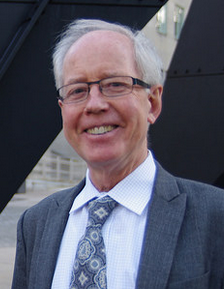
Prinn, Ronald G.

Email: rprinn@mit.edu
Phone: (617) 253-2452
Office: MIT Bldg. 54-1312A
TEPCO Professor of Atmospheric Science,
Department of Earth, Atmospheric and Planetary Sciences (EAPS);
Director, Center for Global Change Science (CGCS);
Director, Joint Program on the Science and Policy of Global Change (JPSPGC);
Massachusetts Institute of Technology, Cambridge MA 02139, U.S.A.
Professor Prinn's research interests incorporate the chemistry, dynamics, and physics of the atmospheres of the Earth and other planets, and the chemical evolution of atmospheres. He has been a faculty member at MIT since 1971, and headed the MIT Department of Earth, Atmospheric and Planetary Sciences from 1998 to 2003. He is currently involved in a wide range of projects in atmospheric chemistry and biogeochemistry, climate science, and integrated assessment of science and policy regarding climate change. He leads the Advanced Global Atmospheric Gases Experiment (AGAGE), in which the rates of change of the concentrations of the trace gases involved in the greenhouse effect and ozone depletion have been measured continuously over the globe for the past three decades. He is pioneering the use of inverse methods, which use such measurements and three-dimensional models to determine trace gas emissions and understand atmospheric chemical processes, especially those processes involving the oxidation capacity of the atmosphere. He is also working extensively with social scientists to link the science, economics and policy aspects of global change. He has co-led the development of a unique integrated global system model coupling economics, climate physics and chemistry, and land and ocean ecosystems, which is used to estimate uncertainty in climate predictions and analyze proposed climate policies. He has made significant contributions to the development of national and international scientific research programs in global change. He served as one of the Lead Authors in the Fourth Assessment of the Intergovernmental Panel on Climate Change (IPCC) published in 2007. He has served as Chairman for Atmospheric and Hydrospheric Sciences of the American Association for the Advancement of Science (AAAS), and has chaired the Steering Committees for the IGBP/IAMAP International Global Atmospheric Chemistry Project, the U.S. National Research Council (NRC) Committee on Earth Sciences, and the U.S. Global Tropospheric Chemistry Program. He has been a member of the Steering Committees of the International Geosphere-Biosphere Program (IGBP), and the NASA Network for Detection of Atmospheric Composition Change, and a member of the IAMAP International Commission on Atmospheric Chemistry and Global Pollution, the NRC Space Science Board, the NRC Committee for the International Geosphere-Biosphere Program, the NASA Space Science and Applications Advisory Committee, and the NASA Earth System Sciences Committee. He has twice testified to the United States Congress on climate change science and its implications for policy. He is a Fellow of the American Geophysical Union (AGU), a recipient of AGU's Macelwane Medal, and a Fellow of the AAAS. He has published more than 250 peer-reviewed scientific papers, co-authored Planets and their Atmospheres: Origin and Evolution (Academic Press), and edited or co-edited Global Atmospheric-Biospheric Chemistry (Plenum), Atmospheric Chemistry in a Changing World (Springer), and Inverse Methods in Global Biogeochemical Cycles (AGU).
Education: Sc.D., 1971, MIT; M.S., 1968, B.S., 1967, University of Auckland, New Zealand.
Curriculum Vitae [pdf]