| ||||||||||||||||||||
|
|
||||||||||
|
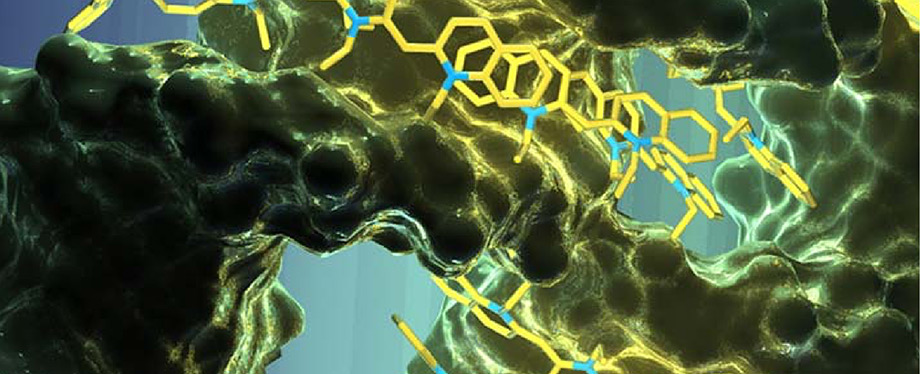
Work on the mechanisms of antitumor drug action focuses in part on cis-diamminedichloroplatinum(II) (cisplatin), which binds to DNA to form adducts that block the enzymes associated with tumor cell DNA replication and transcription. We discovered that the transcription factor hUBF, which controls rRNA production, binds tightly to the major DNA adduct of cisplatin. The Kd of this association is in the pM range, which is within threefold of the binding affinity of hUBF for the rRNA promoter. Current efforts are aimed at establishing whether cisplatin adducts act as decoys that disrupt transcription of the rRNA gene and other genes regulated by related transcription factors. The third area of research in the Essigmann laboratory concerns the synthesis of programmable therapeutics. Bifunctional molecules are being prepared in which a DNA damaging warhead is linked to a molecular recognition domain for proteins that are over expressed in tumors (e.g., steroid receptors). Following DNA damage, the molecular recognition domain attracts the over expressed nuclear proteins. The formation of the protein-adduct complex sterically hinders the repair of the adduct, causing the adduct to persist and enhancing the likelihood that it will kill the cell. In non-tumor cells, adduct repair is rapid and hence those cells suffer less toxicity. Molecules have also been designed to alter the ability of specific transcription factors to function normally. In cancer cells, many transcription factors are over expressed and they are therefore targets for this therapeutic strategy. Because the protein recognition domain can be tailored to attract many different tumor specific proteins, the general approach has been termed "fatal engineering." Out of these efforts, molecules that have shown promise in vivo against breast and prostate cancer have been evolved. The one developed against prostate cancers is of particular interest because it circumvents that apoptotic blockade that typically protects prostate cancer cells from therapeutic alkylating agents.
Zdraveski, Z.Z., Mello, J.A., Farinelli, C.K., Essigmann, J.M. and M.G. Marinus. MutS preferentially recognizes cisplatin- over oxaliplatin- modified DNA. J. Biol. Chem., 277: 1255-1260 (2002). Henderson, P.T., Delaney, J.C., Gu, F., Tannenbaum, S.R. and J.M. Essigmann. Oxidation of 7,8-dihydro-8-oxoguanine affords lesions that are potent sources of G to T transversions in vivo. Biochemistry, 41: 914-921 (2002). Delaney, J.C., Henderson, P.T., Helquist, S.A., Morales, J.C., Essigmann, J.M., and E.T. Kool. High-fidelity in vivo replication of DNA base shape mimics lacking the ability to form Watson-Crick hydrogen bonds. Proc. Natl. Acad. Sci. (USA). In press. Mitra, K., Marquis, J.C., Hillier, S.M., Rye, P.T., Zayas, B., Lee, A.S., Essigmann, J.M., and R.G. Croy. A rationally designed genotoxin that selectively destroys estrogen receptor-positive breast cancer cells. J. Amer. Chem. Soc., 124: 1862-1863 (2002). Delaney, J.C. and J. M. Essigmann. Effect of sequence context on O6-methylguanine repair and replication in vivo. Biochemistry, 40: 14968-14975 (2001). Smela, M.E., Currier, S.S., Bailey, E.A. and J.M. Essigmann. The chemistry and biology of aflatoxin B1: From mutational spectrometry to carcinogenesis. Carcinogenesis 22: 535-545 (2001). Kartalou, M. and J.M. Essigmann. Recognition of cisplatin adducts by cellular proteins. Mutation Research 478: 1-21 (2001). Kartalou, M. and J.M. Essigmann. Mechanisms of resistance to cisplatin. Mutation Research, 478: 23-43 (2001). |
|||||||||||